

(415) 717-7243
Beyond the Down Payment: What to Budget for When Buying a Home in Petaluma
What costs should you budget for when buying a home in Petaluma?

Your down payment is only part of the picture. Plan for closing costs, inspections, insurance, property taxes, moving expenses, ongoing maintenance, and any property-specific costs such as HOA dues or solar payments. The goal is to understand both the cash you need to complete the purchase and the expenses you will carry afterward. California’s Department of Real Estate encourages buyers to account for these costs—not just the mortgage payment—when planning a purchase.dre.ca
You may have saved for a down payment and found a monthly mortgage payment that looks manageable. But before you make an offer, ask a broader question: Will this home still fit your budget once all the other costs are included?
Here is how I recommend organizing your budget before buying in Petaluma.
1. Separate Your Down Payment From Closing Costs
The down payment is the portion of the purchase price you contribute rather than finance. Closing costs are the additional expenses associated with obtaining the loan and completing the transfer of ownership.
Depending on the transaction, closing costs may include:
- Loan origination and other lender charges.
- Appraisal fees.
- Title and escrow charges.
- Recording fees.
- Prepaid interest.
- Insurance premiums.
- Initial deposits into an escrow account for taxes and insurance.
Your lender’s Loan Estimate itemizes estimated loan costs and other closing expenses. Review the actual figures rather than relying only on a general percentage of the purchase price.consumerfinance
Ask your lender:
- Which charges are lender fees?
- Which services can I shop for?
- Does the quoted rate include discount points?
- Are there lender credits, and how do they affect the loan?
- What costs could change before closing?
For an overview of the purchase process, start with my Buyer’s Guide.
2. Understand Your Cash to Close
“Closing costs” and “cash to close” are not interchangeable.
Your estimated cash to close generally includes your down payment and closing costs, reduced by deposits already paid, applicable credits, and other adjustments. The Loan Estimate shows how that amount is calculated.consumerfinance
For example, your earnest-money deposit is generally credited toward the purchase; it is not automatically an additional expense on top of the down payment. Ask your lender and escrow officer to explain how it appears in your transaction.
Keep three amounts separate in your planning:
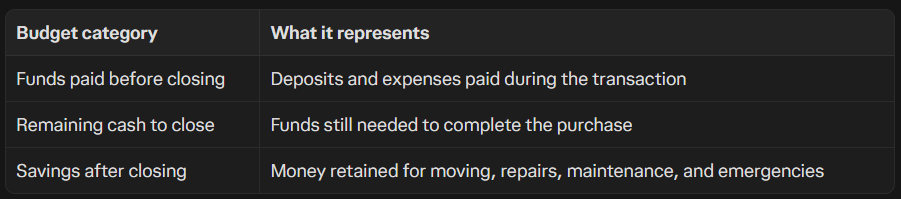
This helps you avoid counting the same money twice—or committing all your available savings to closing.
3. Budget for Inspections and Follow-Up Evaluations
A home tour helps you decide whether a property interests you. Inspections help you investigate its condition more thoroughly.
Depending on the property and available reports, discuss whether you need:
- A general home inspection.
- A pest inspection.
- A sewer lateral inspection.
- A roof, electrical, plumbing, or structural evaluation.
- A pool inspection.
- Other specialist reviews prompted by disclosures or inspection findings.
Ask which evaluations are appropriate, what they cost, and when payment is due. Some expenses may be incurred even if you ultimately decide not to complete the purchase, so include them in your transaction budget.
A property’s purchase price is not its only financial consideration. California’s buyer guidance specifically identifies repairs and upgrades as costs buyers should plan for.dre.ca
4. Review the Full Monthly Payment
A mortgage calculator may show only principal and interest. That is not necessarily your full monthly housing expense.
Your budget should account for:
- Principal and interest.
- Property taxes.
- Homeowners insurance.
- Mortgage insurance, if applicable.
- HOA dues, if applicable.
- Any property-specific assessments or obligations.
The Loan Estimate separates projected payments and identifies estimated taxes, insurance, and assessments. Check whether those items are included in the payment or must be paid separately.
When comparing Petaluma homes, use a property-specific estimate. Two homes with similar asking prices may have different insurance costs, association dues, maintenance needs, or other expenses.
5. Get an Insurance Quote Early
Do not assume that the premium for your current residence—or an estimate in an online calculator—will apply to the home you want to buy.
Ask an insurance professional for a quote based on the specific property. Review the premium, deductible, coverage limits, exclusions, and whether additional coverage is appropriate.
The Consumer Financial Protection Bureau recommends shopping for homeowners insurance and comparing the combination of premium, coverage, and service. Your lender will also need evidence of the required insurance for the new home.files.consumerfinance
Discuss insurance early enough that you have time to understand your options before making important contractual decisions.
6. Look at Utilities and Property-Specific Expenses
Ask the seller for available information about recurring costs. A full year of utility bills can provide more context than a single month, although your usage may differ.
Expenses to investigate include:
- Electricity and gas.
- Water and sewer.
- Garbage service.
- Landscaping.
- Pool service.
- HOA dues.
- Solar financing, lease payments, or power-purchase obligations.
- Maintenance associated with the home’s systems and outdoor areas.
If the property has solar, ask how the system is owned and billed. If there is an HOA, review its financial information, maintenance responsibilities, insurance, and assessment disclosures.
The purpose is not to predict every bill exactly. It is to identify obligations that a mortgage estimate does not capture.
7. Leave Room for Moving and the First Year
After closing, you may still need to pay for movers, storage, cleaning, furniture, window coverings, or immediate repairs.
Separate first-year expenses into three groups:
Necessary soon
Items needed for safety, function, or essential daily use.
Important but flexible
Work that would improve comfort or usability but can wait.
Optional
Cosmetic changes or purchases you would like to make later.
This distinction can help you avoid treating every improvement as an immediate obligation. Before taking on a major project, obtain estimates from qualified professionals rather than assuming the cost.
8. Compare Homes by Total Cost, Not Just Price
A lower-priced home is not automatically the less expensive choice. It may require more work, have higher recurring expenses, or leave you with fewer reserves after closing.
Use the same budget categories for every serious contender:
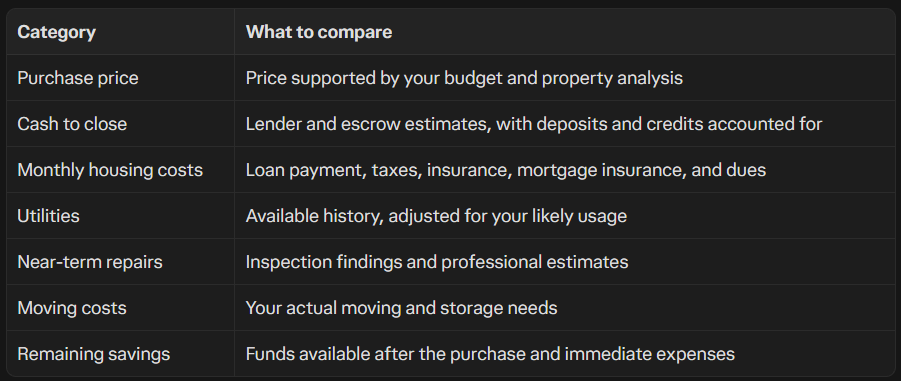
For questions about how a home’s asking price relates to comparable sales, my article on what drives home prices offers additional context.
Frequently Asked Questions
Are closing costs included in my down payment?
No. They are separate categories. Your Loan Estimate shows estimated closing costs and combines them with the down payment and other adjustments to calculate cash to close.consumerfinance
Can I ask a seller to help with closing costs?
You can discuss requesting a seller credit with your agent and lender. Whether it is accepted depends on the negotiations, and the lender must confirm what your loan program permits. Seller credits can affect the cash-to-close calculation.consumerfinance
My article on how the take-it-or-leave-it attitude is changing provides background for that conversation—not a guarantee that a particular seller will offer concessions.
When will I know my final loan costs?
For most covered mortgages, you receive a Closing Disclosure at least three business days before closing. It provides details about the loan terms, fees, and costs. Compare it with your Loan Estimate and ask about changes before signing.files.consumerfinance
How much should I keep in savings after closing?
There is no single amount that fits every buyer. Consider your income stability, other obligations, the home’s condition, planned repairs, and comfort with unexpected costs. Discuss any lender-required reserves separately from the savings you want to retain for your own peace of mind.
Bottom Line
A workable Petaluma homebuying budget includes more than a down payment and an advertised mortgage payment. Understand your cash to close, full monthly expenses, likely first-year costs, and the savings you will retain afterward.
When you are ready to explore homes in Petaluma, contact me to discuss your priorities and the questions to work through with your lender before making an offer.

What should you check when touring a home in Novato?

Can You Buy Your Next Petaluma Home Before Selling Your Current One?

Getting ready to sell your Novato home? Follow this practical timeline for repairs, staging, disclosures, pricing, photos, and showings before you list.

Compare real estate agents in Petaluma and Novato beyond star ratings. Learn how to assess reviews, sales results, local expertise, strategy, and fees.

Compare real estate agents in Petaluma and Novato with this buyer and seller guide. Evaluate local experience, marketing, negotiations, reviews, fees, and strategy.

Mortgage rates may change, but you can still influence your loan terms. Learn how credit, loan options, lender comparisons, and buyer incentives can affect your mortgage rate.

Use this step-by-step checklist to choose a Novato real estate agent. Compare local experience, strategy, communication, reviews, fees, and contracts before you buy or sell.

Best Real Estate Agent in Petaluma & Novato: How to Choose the Right Local Expert for Your Next Move
Learn how to choose the best real estate agent in Petaluma or Novato. Compare local expertise, reviews, strategy, communication, negotiations, and fees before you hire.

Learn how to choose the best real estate agent in Petaluma or Novato. Compare local experience, reviews, strategy, communication, fees, and recent results before you hire.

Use this local checklist to interview and compare real estate agents before selling your home in Santa Rosa, Petaluma, or Rohnert Park. Review pricing, marketing, fees, and experience.