

(415) 717-7243
3 Things You Can Actually Control About Your Mortgage Rate Right Now
What can you control about the mortgage rate you receive?

You cannot control the direction of the overall mortgage market, but you can influence the rate and loan terms you may qualify for. Your credit profile, loan structure, down payment, property type, and lender comparison all play a role in the financing options available to you.
Mortgage rates have moved higher recently. In mid-September, national averages for a 30-year fixed mortgage were roughly in the high-6% to low-7% range, depending on the data source, borrower profile, loan type, and points paid.
That does not mean you need to put your plans on hold. It means it is more important to focus on the parts of the process you can influence.
1. Strengthen Your Credit Profile
Your credit profile is one of the biggest factors lenders consider when determining your rate and loan terms. Generally, borrowers with stronger credit have access to a wider range of financing options and may qualify for more favorable pricing.
Before applying for a mortgage, consider:
- Checking your credit reports for errors.
- Paying bills on time.
- Reducing revolving credit-card balances where possible.
- Avoiding new debt or major credit changes before closing.
- Asking a loan officer what credit score range is relevant to the programs you are considering.
- Understanding how a lender evaluates your income, debt, assets, and overall loan file—not just your score.
A small improvement can matter, but avoid making financial changes based only on general online advice. Ask a qualified lender to explain which steps may help your specific application and how long any changes could take to affect it.
If you are preparing to buy in Petaluma or Novato, it can also help to start with Katia’s Buyer’s Guide so you can organize your home search, financing questions, and timeline before you begin touring homes.
2. Compare Loan Types and Terms
The interest rate you are quoted is tied to the type of loan, length of the loan, down payment, borrower profile, property, occupancy, and other program requirements. There is no single “best” mortgage for every buyer.
A lender may discuss options such as:
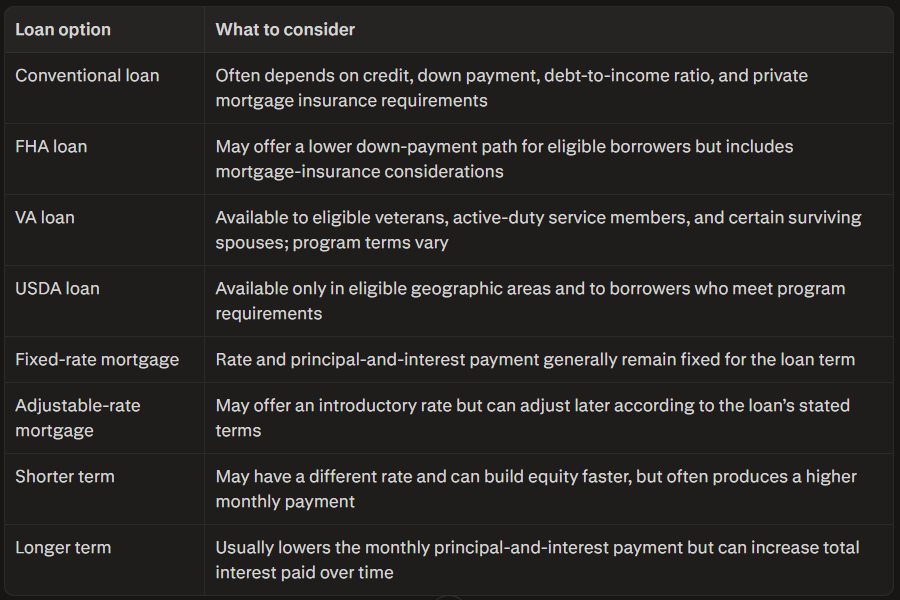
Ask lenders to show you more than one option and explain the tradeoffs in writing. Compare the interest rate, annual percentage rate, estimated payment, cash needed to close, mortgage insurance, points, lender credits, and the cost of keeping the loan over time.
A lower starting rate is not always the better choice if it requires costly points, creates a payment you are not comfortable with, or adjusts in a way that does not fit your plans.
3. Consider New Construction and Seller Incentives
The home you choose can affect your financing options. Builders sometimes offer incentives, including closing-cost assistance or rate buydowns, to make a newly built home more attractive to buyers. In a resale transaction, some sellers may also be open to concessions depending on the property, local competition, offer terms, and negotiations.
A temporary or permanent rate buydown can reduce the borrower’s interest rate, but the value depends on:
- The cost of the buydown.
- Who is paying for it.
- How long you expect to keep the home and loan.
- Whether the reduced rate is temporary or permanent.
- The terms of the program.
- Whether a lender credit or seller concession would be more useful for your situation.
Ask your lender to compare the scenarios with actual estimates. Ask your agent to help you identify properties where incentives may be available and structure an offer that reflects both the home’s value and your overall budget.
It can also be useful to read Katia’s article about how the take-it-or-leave-it attitude is fading from the market. In some situations, buyer-friendly terms such as credits or concessions may be worth discussing, though they are never guaranteed.
One More Smart Step: Compare Lenders
Loan pricing can vary between lenders, even for the same borrower and the same type of loan. Consider speaking with more than one qualified lender and comparing written estimates that are based on the same loan scenario.
For an apples-to-apples comparison, provide each lender with the same information:
- Intended purchase price.
- Down payment.
- Property type and occupancy.
- Estimated credit-score range.
- Desired loan type and term.
- Whether you are considering points or lender credits.
- Expected timing.
Then compare:
- Interest rate.
- APR.
- Monthly principal-and-interest payment.
- Mortgage-insurance costs.
- Lender fees.
- Discount points.
- Lender credits.
- Estimated cash to close.
- Rate-lock terms and expiration.
- Whether the lender can close within your target timeline.
The rate advertised online may not be the rate you qualify for. Your final terms depend on your full financial profile, loan program, property, market conditions, and timing.
Questions to Ask a Lender
Use these questions to make the conversation more productive:
- Which loan programs fit my credit, down payment, income, and home-search goals?
- What rate, APR, payment, and cash-to-close estimate would I receive under each option?
- Is this rate based on discount points, and what is the break-even period?
- What would a temporary or permanent buydown look like?
- Could seller or builder concessions be used toward closing costs or a rate buydown?
- What documentation will you need from me?
- What financial changes should I avoid before closing?
- How long can I lock the rate, and what happens if closing is delayed?
- What could cause my loan terms to change before closing?
- Can you provide a written Loan Estimate for comparison?
Bottom Line
You cannot control daily mortgage-rate movement, but you can take steps to improve the terms available to you. Focus on your credit profile, compare loan structures, understand incentives and buydowns, and obtain written estimates from more than one lender.
When you are ready to explore homes in Petaluma or Novato, Katia can help you evaluate property options, potential incentives, and offer terms that fit your budget and priorities.

Getting ready to sell your Novato home? Follow this practical timeline for repairs, staging, disclosures, pricing, photos, and showings before you list.

Compare real estate agents in Petaluma and Novato beyond star ratings. Learn how to assess reviews, sales results, local expertise, strategy, and fees.

Compare real estate agents in Petaluma and Novato with this buyer and seller guide. Evaluate local experience, marketing, negotiations, reviews, fees, and strategy.

Use this step-by-step checklist to choose a Novato real estate agent. Compare local experience, strategy, communication, reviews, fees, and contracts before you buy or sell.

Best Real Estate Agent in Petaluma & Novato: How to Choose the Right Local Expert for Your Next Move
Learn how to choose the best real estate agent in Petaluma or Novato. Compare local expertise, reviews, strategy, communication, negotiations, and fees before you hire.

Learn how to choose the best real estate agent in Petaluma or Novato. Compare local experience, reviews, strategy, communication, fees, and recent results before you hire.

Use this local checklist to interview and compare real estate agents before selling your home in Santa Rosa, Petaluma, or Rohnert Park. Review pricing, marketing, fees, and experience.

Learn how to choose the right Sonoma and Marin County REALTOR® with this interview checklist for home buyers and sellers. Compare experience, strategy, communication, fees, and local expertise.

Learn how to choose the best real estate agent in Santa Rosa, CA. Compare local experience, client reviews, marketing strategy, communication, and recent results before you hire.

How can you effectively interview and hire the right listing agent in Petaluma, Rohnert Park and Novato?