

(415) 717-7243
Why Staging Your House Could Pay Off This Spring
Why Staging Your House Could Pay Off This Spring

Selling your house this season? You’ve probably heard you should stage it before it hits the market. But what does that really mean, and is it worth the effort? The short answer is yes, especially right now.
With more homes for sale this year, you’re likely wondering how to make the most money possible without your house sitting on the market. The answer is staging. It can help your house stand out, bring in stronger offers, and sell faster. As Nadia Evangelou, Principal Economist at the National Association of Realtors (NAR), puts it:
“Staging matters. Preparing the home to be ‘buyer-ready’ attracts more buyers, especially now that inventory has increased.”
Here’s what staging actually involves and what it could do for your sale.
What Is Home Staging?
Home staging is the process of preparing your house so it appeals to as many buyers as possible. That usually means decluttering, deep cleaning, rearranging furniture, and adding simple touches that help each room feel bright, open, and welcoming.
The goal is to help buyers fall in love with the space and picture themselves living there, which makes them more likely to make an offer. Katia Bidaurreta real estate expert.
Why Staging Is Worth the Effort
Staged houses tend to perform better on almost every metric that matters when you sell. According to Redfin, staged homes have been shown to sell up to 73% faster than unstaged homes. And they often close in under a month, compared to anywhere from two to three months for vacant ones.
There’s also a strong return on the money you spend.
The Home Staging Institute says mid-level staging can deliver a 350% return on investment. On a $400k home, that turns the typical $4k cost into roughly $18k in added value when you sell (see graph below):
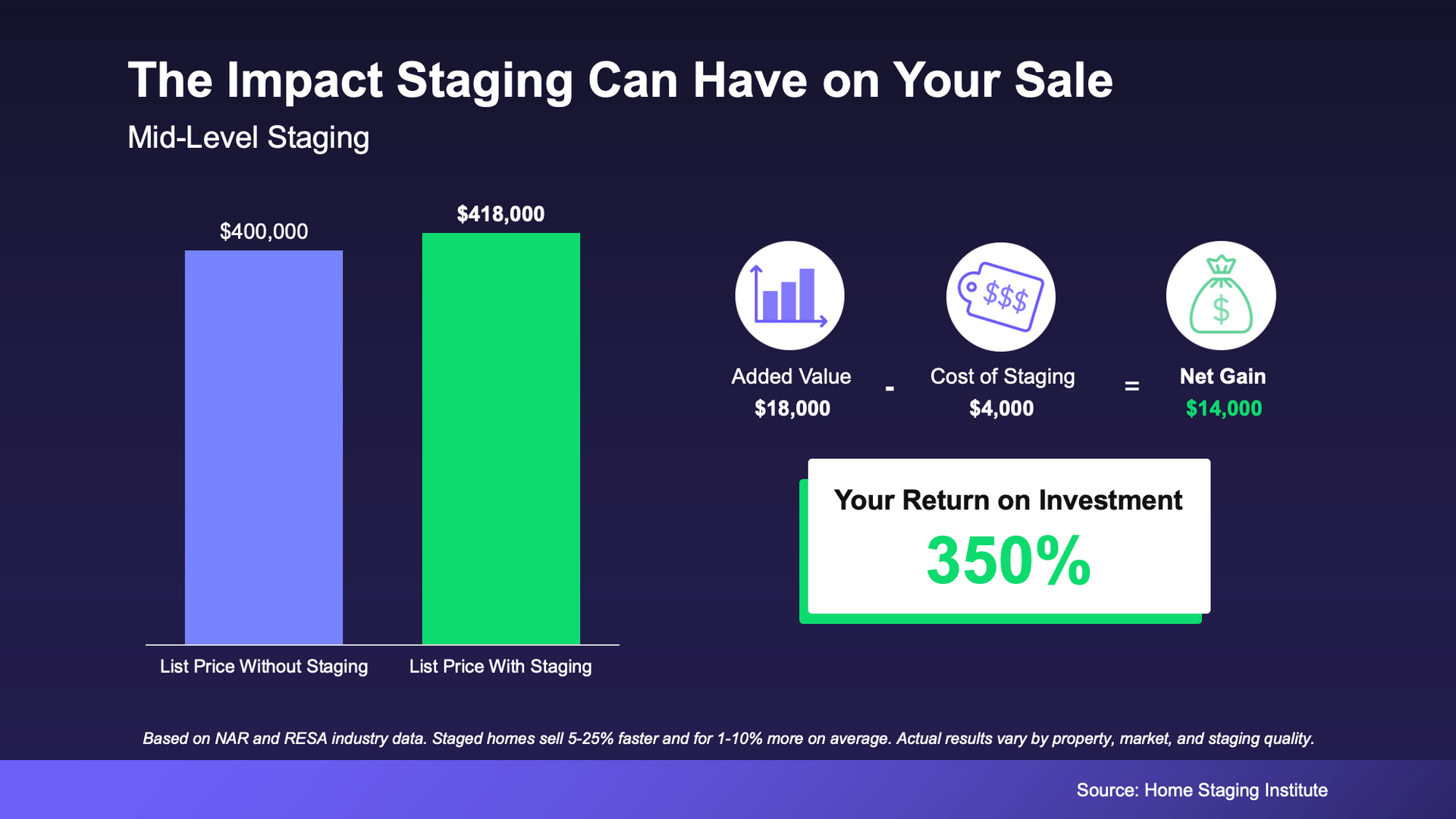
By that estimate, that’s an extra potential profit of about $14k — a meaningful boost when you’re trying to maximize what you walk away with at closing. See why presentation matters when selling your home.
Your Staging Options
And just in case you’re seeing that $4k upfront investment above and thinking, “I’m not going to spend that,” here’s what you should know.
Staging doesn’t always have to mean hiring a full crew or filling your house with rented furniture. There are a few different paths you can take, depending on your budget and timeline. So, you could spend a lot less and still get a good return.
Here are a few options:
- Professional staging. A stager handles everything from layout to décor, often bringing in their own inventory. According to the Home Staging Institute, costs typically range from $500 to $5k or more, depending on the size of your house.
- Virtual staging. Digital furniture and styling are added to your listing photos, which can be a budget-friendly option for vacant houses.
- DIY staging. If your budget is tight and your home only needs minor updates, decluttering, deep cleaning, and arranging furniture for flow can still make a real difference.
Your agent can help you figure out which approach fits your house, your market, and your goals. Visit Katia’s Home Seller’s Guide.
What Buyers Notice First
Agents see what buyers respond to in open houses and showings every week, so they can give you specific, personalized recommendations on what’s worth your time and money — and what isn’t.
That way you can get the most bang for your buck, no matter your budget. Read more about pricing your home for today’s market.
Bottom Line
With more homes for sale right now, making a strong first impression matters. Staging can help your house sell faster and for more — and there’s an option for almost every budget.
If you’re getting ready to list, let’s talk about what level of staging makes sense for your house and make a plan for attracting the right buyers. Contact Katia Bidaurreta for staging advice.

Touring homes in Novato? Use this buyer checklist to evaluate layout, condition, insurance, permits, solar costs, disclosures, and ownership expenses before you offer.

Can You Buy Your Next Petaluma Home Before Selling Your Current One?

Getting ready to sell your Novato home? Follow this practical timeline for repairs, staging, disclosures, pricing, photos, and showings before you list.

Compare real estate agents in Petaluma and Novato beyond star ratings. Learn how to assess reviews, sales results, local expertise, strategy, and fees.

Compare real estate agents in Petaluma and Novato with this buyer and seller guide. Evaluate local experience, marketing, negotiations, reviews, fees, and strategy.

Mortgage rates may change, but you can still influence your loan terms. Learn how credit, loan options, lender comparisons, and buyer incentives can affect your mortgage rate.

Use this step-by-step checklist to choose a Novato real estate agent. Compare local experience, strategy, communication, reviews, fees, and contracts before you buy or sell.

Best Real Estate Agent in Petaluma & Novato: How to Choose the Right Local Expert for Your Next Move
Learn how to choose the best real estate agent in Petaluma or Novato. Compare local expertise, reviews, strategy, communication, negotiations, and fees before you hire.

Learn how to choose the best real estate agent in Petaluma or Novato. Compare local experience, reviews, strategy, communication, fees, and recent results before you hire.

Use this local checklist to interview and compare real estate agents before selling your home in Santa Rosa, Petaluma, or Rohnert Park. Review pricing, marketing, fees, and experience.